This is my review about the new Viltrox AF 90mm f/2.2 EVO lens. A compact, lightweight and bright (portrait)lens for crop sensor cameras. I’m using the Nikon Z version of this lens on my Nikon Z cameras (Zfc, Zf, Z6III). The lens is also available for Sony E and FujiFilm X-mount.

When you are looking for a portrait lens for your crop sensor camera you’ll find there are more than enough lenses in the 75-90mm range. But in the case of Nikon Z you are mainly limited to full frame lenses. For Nikon for instance there is a very nice full frame Nikon Z 85mm f/1.8S lens. Attaching such a lens to your crop sensor camera will get you an equivalent field of view of just under 130mm. But the downsides are evident, the Nikon 85mm S is an expensive lens, with EU MSRP of 939 euro. And it isn’t especially small or light either at 470 grams. Which is fine for a Full Frame prime lens, but on your APS-C camera you aren’t even using most of the image circle.
That’s where the subject of this review comes in. The Viltrox AF 90mm f/2.2 EVO offers a compact, lightweight (about 25% lighter than the full frame Nikon) and affordable alternative for the Full Frame portrait lenses. And it is available for € 425 of $ 369, which is very affordable for a lens like this. In this review I’ll tell you if it is any good.
Interested in this lens? If you use my discount code RICKSREVIEWS on the official Viltrox Shop you’ll receive a 5% discount.

Ricks Reviews verdict
Pros
- Compact
- Bright maximum aperture
- Very nice Bokeh
- Very good flare resistance
- Fantastic image quality
- Very good build quality
- Great focal length for portraits and general tele-use
Cons
- Not that different from other Viltrox lenses like the 85mm for full frame
- APS-C only
Best for:
Portrait photography, product photography, creative landscape photography, animals, street photography.
Not ideal for:
Architecture, wide landscapes, fast paced reportage photography.
Would I buy it again?
Yes, definitely – the lens is small, affordable and has great image quality. A big upgrade for your APS-C camera.
Viltrox AF 90mm f/2.2 EVO features
The new 90mm EVO lens has a design that is consistent with other Viltrox EVO lenses. This means a professional looking and feeling design. The body is made of a combination of metal and high quality plastics. The mount is metal and offers a rubber gasket. Viltrox doesn’t promise any weather sealing, but the fit and finish are very good and tight.

The lens itself has multiple control points. There is a very nice manual aperture ring, that has the option to be de-clicked. For automatic aperture control you can park the ring in the A setting, which it does with a very nice and subtle click. On the other side of the lens there is an AF/ manual focus switch and up front you have a well dampened focus ring. There is also a programmable FN-button. The lens comes with a nice, matte plastic sun hood and a protective bag.

Stabilisation
One thing to notice is that this Viltrox lens, like many other (bright) primes, doesn’t have stabilisation built-in. For many Sony or FujiFilm APS-C users this will not be a problem. Many of their APS-C camera’s offer IBIS that works very well with the Viltrox 90mm. For Nikon the situation is different since all of Nikon’s current DX/ APS-C models lack IBIS. This means that with the rather long focal length you need to make sure your shutter speed is high enough to prevent image shake. Not really a problem with the bright aperture, but something to keep in mind to get the best results. By the way, this is also true for many other prime lenses, including the Z 85mm f/1.8S I mentioned earlier.

Specifications
The Viltrox AF 90mm f/2.2 EVO has a quite complex lens design. It has 10 elements in 8 groups that include 2 ED en 2 HR elements. This should give sharp, vibrant results with low aberrations.

The other most relevant specifications are:
- 90mm focal length – comparable to 135mm on full frame
- Bright f/2.2 maximum aperture
- 9 rounded aperture blades
- APS-C compatible
- Available for Sony E, FujiFilm X and Nikon Z-mount
- Full AF support, including (3d-) subject tracking and face and eye detection
- STM motor for quick and silent focusing
- Minimum focusing distance 0,74m with 0,14x magnification
- Filter size 58mm

Image quality & operation
The first thing you might want to know about a lens is sharpness. And you can rest assured, this lens is sharp. I’d say it might even be on the sharp side for my taste when it comes to portrait lenses. For portraits I’d rather have a lens that is a little softer and more forgiving. But on the other hand it is easier to soften an image in post processing than to sharpen it.
In my testing I’ve mainly used the lens wide open, because that is why you’d buy a bright prime lens. And right from f/2.2 this lens offers very high sharpness in the center, with very acceptable corners. When you stop down a bit the center of the image sharpens up just a little since it is already very good wide open. You do get a touch more contrast stopped down. But I’ve never felt the need to stops down to increase sharpness or contrast in the central portion of the image.

Corners are a little behind the center portion of the image when it comes to sharpness. Corners do improve when stopping down, going from f/2.2 to f/5.6 you’ll notice a difference. But mainly when shooting flat surfaces. For shooting portraits corner sharpness isn’t a big issue most of the time.
This can also be a very nice medium tele-lens for landscapes with its 135mm full frame equivalent field of view. In that situation corner sharpness is more important. But since you will probably be at apertures smaller than f/2.2 that will never be an issue, anything from f/4-5.6 will get you very nice corner sharpness.

Vignetting and aberrations
The most apparent image flaw in a lens are probably also the easiest to fix: vignetting and chromatic aberrations. But I was surprised to find that this lens has very low vignetting, even at maximum aperture. Normally bright primes show quite some vignetting. I’ve even double checked to see if I had any corrections applied to the images, but that was not the case. Corners are almost as bright as the rest of the image, only the very extremes of the corner show a moderate shading. I suspect the image circle of this crop lens is bigger than just the APS-C sensor. This means you don’t have to correct for vignetting and don’t lose any dynamic range.

Chromatic aberrations are also low. I’ve pushed the lens to the max with some images of a bike with a lot of high contrast in the chrome. Chromatic aberrations aren’t really a problem for me in most situations as modern editing tools can correct these very well. But not having any is always better. I can’t be any other than impressed by the quality this Viltrox lens offers for the relatively low price.

Bokeh
For a portrait lens the quality of the out of focus region of the image is always important. With a bright prime lens you’ll have the option to blow out the background, so you’ll need the Bokeh to be good. This lens offers ample control over the depth of field. The combination of the f/2.2 maximum aperture and the smaller APS-C sensor makes that you still have enough depth of field to keep a persons face, nose and eyes in focus. After that you’ll see a very nice and graduate fall-off to the out of focus background.

The background itself is very nice. Highlight are soft and have unform lighting. So there are no harsh rings that attract unwanted attention. The highlight are also free of any smudging or union rings most of the time. Towards of the edge of the frame there is a subtle cats-eye effect in the highlights. It is pronounced enough to add some character to the image without the extreme swirly effect. Highlights in the centre portion of the image are nice and round.

When stopping down to f/5.6 the highlights stay nice and round. The corners lose the cats-eye effect when stopped down. The background keeps its soft and subtle look when stopped down.
Flare and sun stars
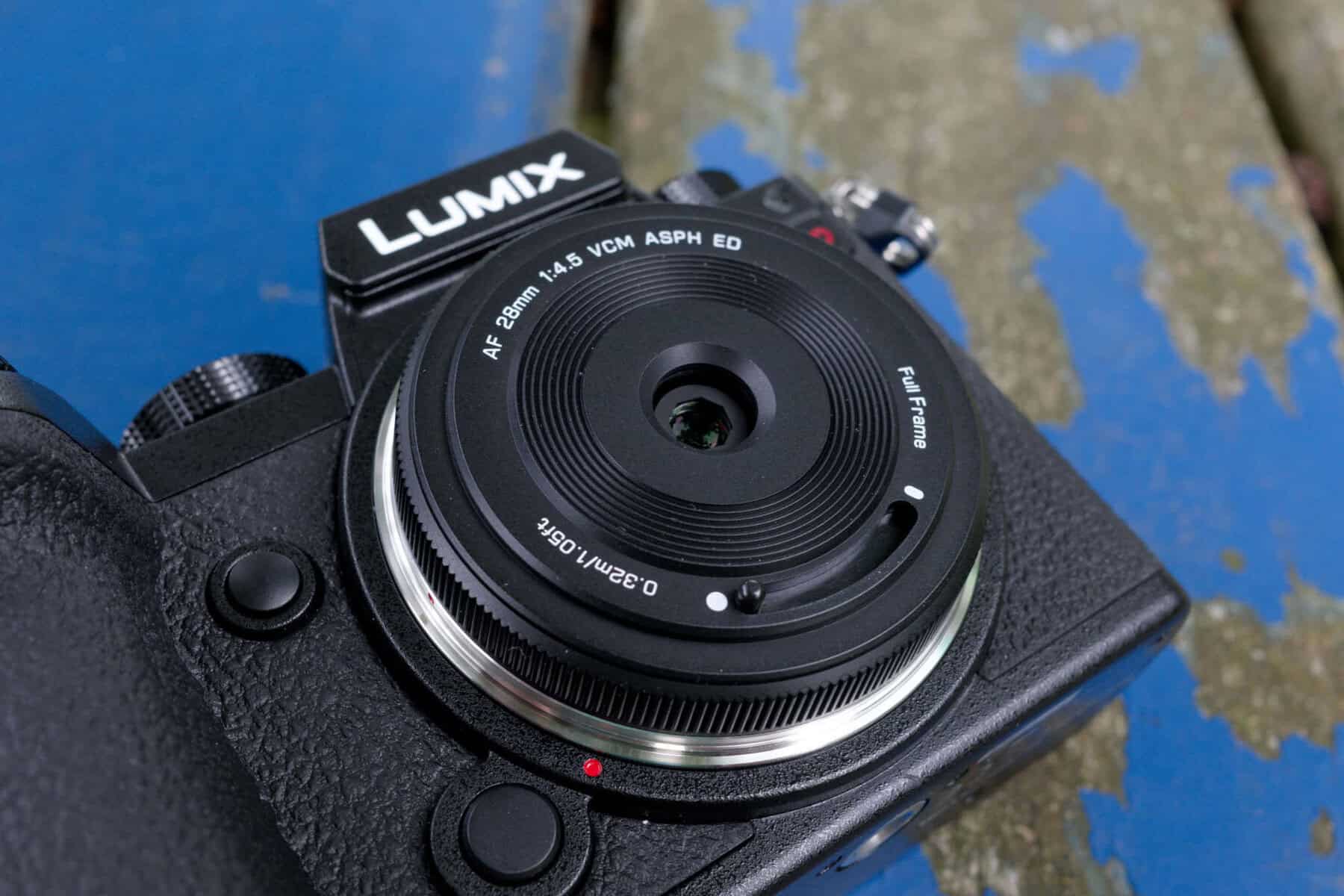
Flare is impressively well controlled by the lens. Viltrox has clearly used high quality coatings in these new EVO lenses. When pointing the lens at a very bright light source it will keep flaring limited. I’ve never seen any apparent loss of overall contrast. Flares never attract too much attention. Viltrox includes a very nice sun hood that will help to keep light away from the front element as well. The flare resistance is quite the difference to the (much cheaper and smaller) Viltrox AF 28mm f/4.5 lens I’ve tested before. The 28mm is more a fun lens, the Viltrox AF 90mm f/2.2 EVO is much more a professional tool.

I wasn’t really expecting the lens to show any usable sun stars, normally bright lenses with nice looking Bokeh don’t do well when it comes to this. The 90mm f/2.2 EVO surprises. As you can see in the image with the bike in b&w above shot at f/5.6 I got some very subtle, but lovely looking sun stars on the bikes chrome. The 9 bladed aperture gives you 18 longer and more pronounced streaks. In between those there are smaller streaks that make the star look very interesting to me. Unexpected bonus!

Autofocus – fast and reliable
The Viltrox AF 90mm f/2.2 EVO offers full autofocus support on the compatible camera’s. This means all the brand specific functionality works with the Viltrox. On Nikon you get full 3D tracking and subject tracking and face and eye detection. In my testing I found autofocus to be reliable and fast in almost every situation. When using eye autofocus the camera found the eye quickly and locked on just as reliable as it does with my native Nikon lenses. Also when using tracking I’ve never found any issues.

The only time when I noticed a small difference with the Viltrox AF 90mm f/2.2 EVO compared to native Nikon lenses was around the minium focusing distance. Here I noticed that the camera could occasionally hunt a little more and longer than expected. Not to the point where it was unusable, but I did notice. Perhaps this is something Viltrox can fix with future firmwares.
Besides the reliable functionality and the very usable speed, focusing was quiet. The STM motor that Viltrox uses is so quiet I never noticed it. It will even be perfectly usable for video, the noise it makes will not be recorded.
Conclusion for the Viltrox AF 90mm f/2.2 EVO
I’ve really enjoyed using the 90mm EVO Viltrox. The lens is small, lightweight and build quality is very good. Because of the small size this lens is perfect for a compact APS-C camera. When it comes to field of view the 135mm equivalent is perfect for portraits. It works very well for head and shoulder images, but also for full body shots with some background.

I found the 90mm focal length and bright maximum aperture to be very usable for other subjects too, like the motorcycles you see on this page. With the f/2.2 aperture you are able to separate your subject from the background without losing all detail.
Image quality is great. No complaints there. The lens is sharp, has low vignetting and controls flares very well. Bokeh is very nice, making this lens perfect for portraits but it also works very well as a medium long tele-lens.
In the past you’d want to steer clear of off-brand lenses, you’d be better off buying brand-own lenses or maybe a Sigma if you expected quality. But in recent years brands like Laowa and Viltrox have proven the enormous steps they have made in the last few years. With a $369 / €429 price tag this lens definitely deserves your attention if you are in the market for a portrait lens for your crop sensor camera.
Interested in this lens? If you use my discount code RICKSREVIEWS on the official Viltrox Shop you’ll receive a 5% discount.
Also interesting for you: my experience with the Viltrox AF 28mm f/4.5 lens on Nikon Z or Leica L-mount and the Viltrox Z1 Vintage Pro on camera flash.